

In the summer of 1947, as the Union Jack came down over Delhi for the last time, the wagers being placed in London and Washington were not about how India would rise. They were about how quickly it would break. There was little certainty that the new nation would survive in anything resembling the form in which it had been born.
Winston Churchill, no friend of Indian self-rule, predicted the new nation would fracture within a generation, its many tongues and gods and castes too much for any constitution to hold together. He was echoing a chorus, not composing a solo. Most western strategists of that era agreed with him.
Seventy-nine years later, that chorus has fallen silent, because it turned out to be wrong. This is not the voice of an uncritical flag-waver. It is the voice of a soldier who spent a career studying how nations fail, and who has come to believe that India’s survival as one republic – diverse, argumentative and free – ranks among the more improbable achievements of the 20th century.
Two democracies, poles apart
For much of the Cold War, India and the United States eyed each other with the wariness of two countries each suspecting the other of having chosen the wrong side. New Delhi’s non-alignment looked, from Washington, indistinguishable from a tilt towards Moscow. Islamabad, not Delhi, held Washington’s telephone number.
The chill was not absolute from the very start, and its arrival was almost accidental. Following China’s invasion in 1962, the Kennedy administration rushed light arms and equipment to a badly bruised Indian Army – a brief warming that the following decade would undo. India’s 1974 nuclear test at Pokhran, euphemistically labelled a peaceful explosion, triggered American non-proliferation sanctions that hardened mutual distrust for the better part of two decades.
The chill had a face too. In 1971, as the Bangladesh war raged, Washington sent the USS Enterprise into the Bay of Bengal in a show of support for Pakistan – a gesture that a generation of Indians has never quite forgotten.
For years before that, India had queued for American wheat under the PL-480 program, dependent and resentful in equal measure. Gratitude and grievance sat uneasily side-by-side, the way they often do between an old power and a young one.
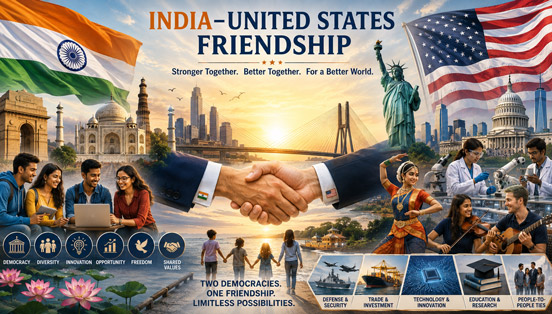
It took the end of the Cold War, and then the 1991 reforms that finally freed the Indian economy from its own caution, to thaw what three decades of summitry could not. The 2005 civil nuclear deal did the rest, turning what diplomats had taken to calling estranged democracies into declared partners.
Ocean apart, people intertwined
Governments took 30 years to warm up to each other. Indians and Americans, left to themselves, moved rather faster. After the 1965 US immigration reforms opened the door, engineers and doctors from India began arriving in American cities in numbers no treaty had authorized, and no Cold War could stop. They built careers, then companies, then entire industries, often while their own governments back home were still arguing.
Today, Indian-Americans run some of the world’s most valuable technology companies, teach in its finest universities and treat its patients in numbers wildly disproportionate to their share of the population. That is only half the story.
The quieter half is what came home. Remittances flowed back by the billions every year. So did something harder to measure – a generation of engineers who studied at MIT or Stanford and returned to seed the software and startup economy that now employs millions inside India itself.
Silicon Valley did not merely take Indian talent. It sent a fair amount of itself back. That closeness eventually travelled beyond boardrooms and campuses into the corridors of American power itself.
A vice-president, a string of state governors and members of Congress from both parties, and prominent contenders in recent presidential primaries have all traced their roots to India, a visibility unthinkable a generation ago. Through the coldest years of government-to-government relations, it was often this diaspora, quietly and without portfolio, that kept the relationship’s pilot light burning.
Strategic partners to stress test
By the 2010s, the relationship had grown into something sturdier – a quadrilateral partnership (Quad) with Japan and Australia, growing defense co-production, deepening cooperation on semiconductors and critical minerals, and a shared, largely unspoken wariness of Chinese ambition. It looked, for a while, settled.
Then came a year that tested it properly. Through 2025, Washington imposed tariffs on Indian goods that climbed in stages to a punishing 50%, penalizing India in part for its continued purchase of discounted Russian oil, and sharp language from President Donald Trump’s own trade officials did little to soften the blow. Political friction compounded the economic pain. Trump’s repeated public claim to have personally brokered a ceasefire between India and Pakistan in May 2025, a claim New Delhi never accepted, added a diplomatic sting that outlasted the trade dispute itself.
Indian confidence in the US president fell hard as a result. A Pew survey in early 2026 found it had slipped to 39%, down from 51?rely a year earlier. A trade deal struck in February 2026 between Trump and Prime Minister Narendra Modi brought the tariffs down to 18% and pulled the relationship back from the ledge. The relief was real but incomplete – fresh American duties on Indian solar exports, and a US Supreme Court ruling complicating Trump’s tariff powers, kept the détente looking provisional rather than settled. Old friendships are not immune to bad years. This one has had a genuinely difficult one, and it has come through it still standing.
Unfinished Republic – and proud of it
None of this argues that India has become everything it once hoped to be. Grinding poverty persists in states that independence was supposed to lift. Communal fault lines still crack open with alarming regularity, and debates over media freedom that should have been settled decades ago remain open wounds.
A soldier does not flinch from naming his own country’s failures. He has usually seen more of them up close than most. Contrast this, though, with the fate of India’s own twin at birth. Pakistan, carved from the same partition and by the same colonial hand, fractured within 25 years, losing its eastern wing to a war of secession in 1971. Across much of the decolonizing world, coups and one-party rule became the default outcome, not the exception, which makes India’s unbroken run of free elections closer to a historical anomaly than a natural result.
But a nation given no more than a generation by its harshest critics has instead built the largest running experiment in democratic self-government the world has attempted, and kept it running for 79 years without once surrendering it to a general’s boot or a dictator’s decree. This soldier included.
That, more than any growth figure or diplomatic communique, is the true measure of what August 15 asks Indians – at home and scattered across the world, from Chamba to California – to celebrate. Not a finished nation. An unfinished one that has simply refused, against every prediction, to fail.
Note: This article was first published on The South Asian Times, NY, USA.